Our definition of a sustainable exhibition stand:

A sustainable exhibition stand is a strategically designed brand space that consistently combines ecological responsibility, economic efficiency and long-term reusability. It is planned, built and operated to minimise resource consumption, emissions and waste — without compromising on design, brand impact or functionality.

Sustainability in exhibition stand construction is not about doing without — it's about intelligent systematics.

Messestand von Sikla mit großem schwarzen Hintergrund, Rohrleitungen als Ausstellungsstücke und Stehtischen mit Stühlen.
circulation

sustainability cycle

Our sustainability cycle is based on a clear principle: thoughtful planning, efficient use, and consistent reuse. We lay the foundation for sustainable brand appearances right from the design stage. Modular systems, durable materials, and flexible constructions ensure that exhibition stands and brand elements can be used, adapted, and further developed over many years.

Planning & Designing

Sustainability begins with planning. We develop trade fair and event concepts with a modular structure, clear material strategy, and realistic multiple use. This results in solutions that work in the long term—technically, creatively, and economically.

Utilize & Further Develop

Our systems are designed for a service life of 5–10 years. After each use, we check the modules, repair or replace individual components, and expand existing systems as needed. This keeps your presentation up to date—without having to rebuild it every time.

Reuse & Recycle

Anything that cannot be reused is recycled properly. Aluminum, wood, and textile elements are returned to the material cycle in a controlled manner. This allows us to reduce waste, conserve resources, and ensure sustainable, responsible trade fair construction.

Nachhaltigkeitskreislauf

Core elements of a
sustainable exhibition stand

1. Modular & reusable construction

A sustainable exhibition stand is built on modular systems (e.g. aluminium frames, plug-in and tensioning systems) that:

• can be used multiple times
• can be flexibly adapted to different stand sizes
• amortise economically across several trade fair cycles

Significantly reduces material consumption, costs and waste.

2. Durable, separable materials

We use high-quality materials that can be cleanly separated by type, such as:

• aluminium
• wood-based materials from certified
forestry
• textile graphics (recyclable, replaceable)

Optimal circularity instead of single-use exhibition construction.

3. Resource-efficient production & logistics

Sustainable exhibition stand construction takes into account:

• regional production
• optimised transport volume
• reduced storage and transport journeys
• durable construction instead of short-lived custom builds

A measurably lower CO₂ footprint per trade fair appearance.

4. Energy-efficient technology

The use of modern technology is an integral part:

• LED lighting with high light output at low consumption
• energy-efficient media technology
• intelligent power distribution

Lower operating costs with maximum impact at distance.

5. Sustainable design with brand focus

We rely on digital solutions to reduce print materials

- QR codes for brochures and information.
- Interactive screens for presentations.

Advantage: less waste and more modern communication.

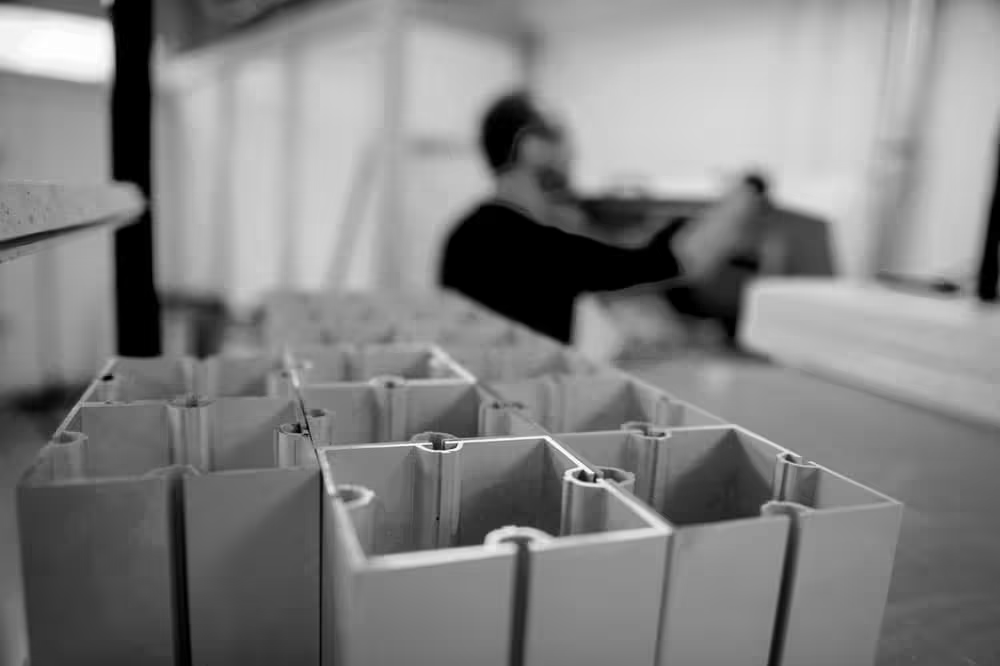
Messesystemträger-Anfertigung: Bohren und WeiterverarbeitenEXFAIR Messesystemträger im Einsatz

Shaping a more sustainable
future together

Sustainability is not a compromise but a benefit for both your business and the environment. By showcasing your brand with a sustainable exhibition stand, you demonstrate responsibility and forward-thinking.

Schubert System Elektronik
CASIO
Sto
Sikla
Hamilton
Gutex
CONTACT
One click, endless possibilities:
We are looking forward to your message!